Quality & process
Quality you cancheck, not just trust.
Every lot is matched to a sample you approve, processed at a licensed partner unit, and tested at an independent, NABL-accredited laboratory whenever you or your market need a certificate. Here is exactly what happens between the field and your door.
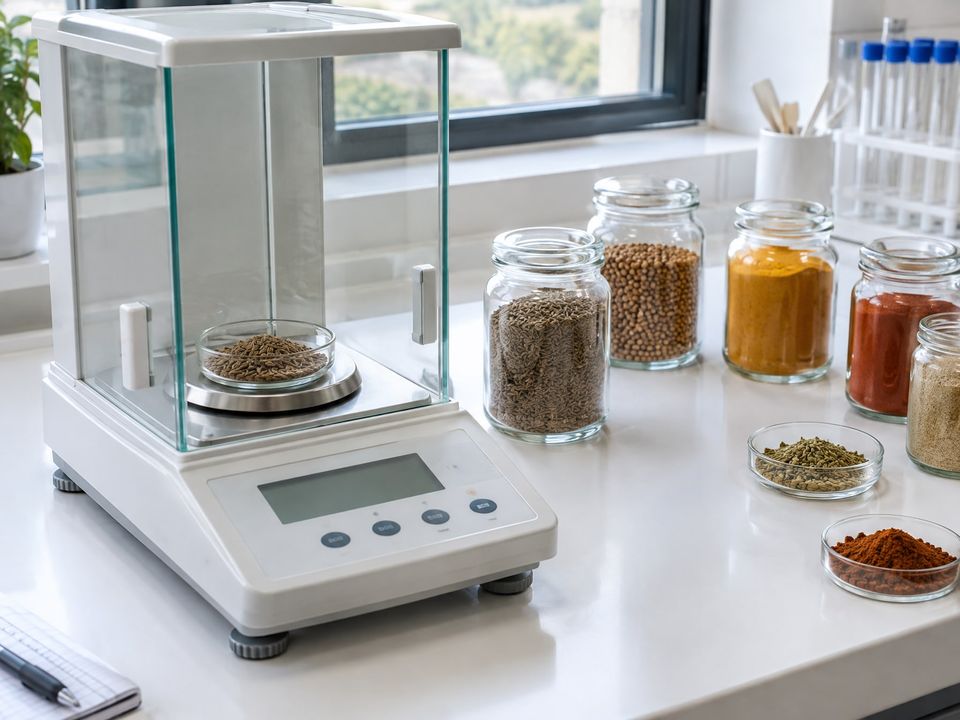
The process
Five steps betweenthe field and your door.
Source
From growers we know and processing units we have visited, from lots we have sampled and seen.
Process
Machine-cleaning, destoning, colour-sorting, hulling, dehydration or milling at the partner unit that specialises in the product.
Test
A sample from every lot goes to an NABL-accredited laboratory for the tests you or your market need.
Pack & label
New bags, cartons or retail packs; every pack carries product, grade and lot number. A retained sample stays with us.
Release
Dispatched only when the lot matches the approved sample and its certificate of analysis.
Partner units
We don't own the machines.We choose them.
Processing happens at specialist units in each cluster. That is the model, not a shortcut — and these are the three rules we hold every partner to.
Licensed
Every unit we use holds a valid FSSAI licence; export lots come from units with ISO 22000 or HACCP where the market expects it. We share the certificates for your due diligence.
Visited
We see the cleaning line, the storage and the hygiene before the first lot, and we go back. Rajkot is within a few hours of every cluster we buy from.
Specialised
Cumin goes to a sortex unit near Unjha, onion to a dehydrator in Mahuva, sesame to a hulling unit. One factory could not do all of this well.
Testing
What we test,and why it matters.
Not every lot needs every test. We agree the tests with you up front, and their cost is shown in the quote. Export lots always ship with a certificate of analysis.
| Test | Why it matters | Usually needed for |
|---|---|---|
| Purity & admixture | Shows how much foreign matter, dust and damaged seed is left after cleaning. | All seed spices and oilseeds |
| Moisture | Too much moisture invites mould and weight loss in transit. | All products |
| Volatile oil | The measure of aroma — what the buyer is really paying for. | Cumin, fennel, coriander, ajwain |
| Pesticide residues | Must meet the maximum residue limits of the importing country. | Export lots, especially EU and UK |
| Ethylene oxide | Banned as a fumigant in the EU; spices are routinely tested for it. | Spices for EU, UK and other strict markets |
| Aflatoxin | A mould toxin with tight limits in food. | Groundnut, chilli, spices |
| Heavy metals | Lead, cadmium and arsenic limits apply in most markets. | Powders, turmeric, export lots |
| Microbiology (e.g. Salmonella) | Required for ready-to-use powders and for strict markets. | Powders, blends; exports to the USA and EU |
| Lead chromate & added colour | Turmeric and chilli are sometimes adulterated with colours; tests catch it. | Turmeric, chilli |
Our rules
Five thingswe won't do.
- Fumigate with ethylene oxide.
- Sell a lot as a grade it doesn't meet.
- Call anything organic without a valid certificate.
- Mix old and new crop without telling you.
- Claim a certification we don't hold.
Have a specification?We'll quote against it.
Send the product, grade, quantity and your city or port. We reply within one working day — Monday to Saturday, 9 AM – 7 PM IST (UTC+5:30).